

Our Reports

Women in Games Manifesto
Guide
The Women in Games Manifesto 2026 showcases our commitment to building a fairer and more inclusive games industry. The Manifesto outlines 14 reasons why gender equality in games matters and sets a framework for change across five key areas: Industry, Education, Policy, Community and Culture. Calling for sustained, collective action to address the continued under-representation of women in leadership and decision-making roles.

Building a Fair Playing Field
Report
We investigate how video games, esports and connected industries can advance gender equality and wider diversity and inclusion. Researched and co-authored by Women in Games CEO Marie-Claire Isaaman and Education & Research Consultant Sharon Tolaini-Sage. This guide presents nearly 150 pages of data, first-hand accounts, and case studies, offering a practical framework for addressing intersectional inclusion at every level of an organisation.
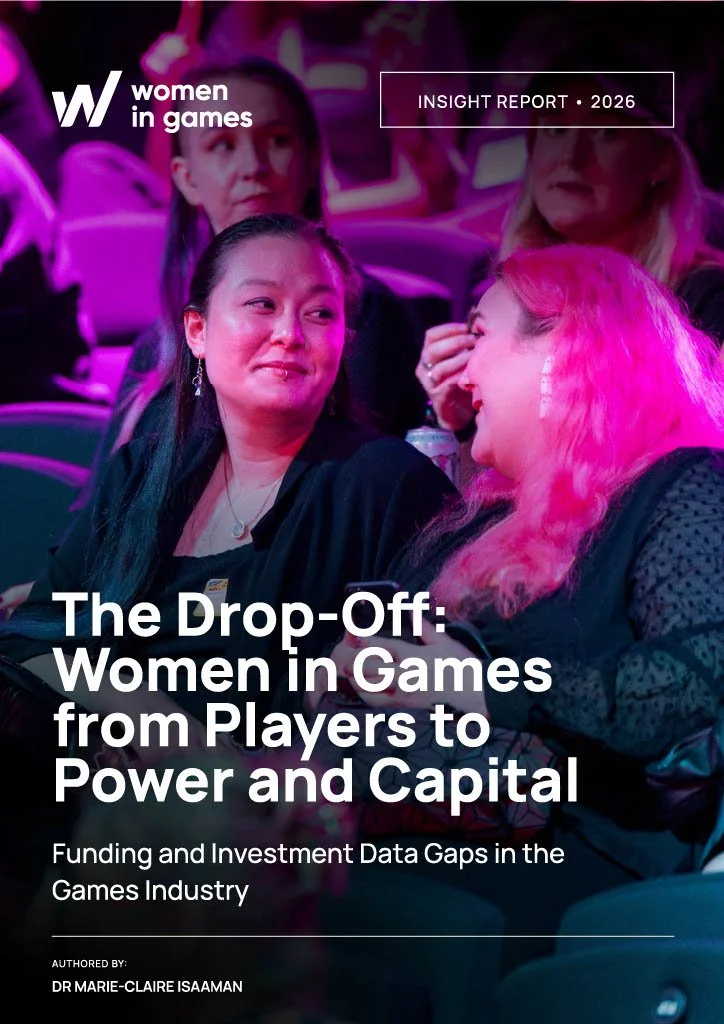
The Drop-Off
Report
This report investigates the funding and investment data gaps affecting women in the global games industry. The Drop-Off presents evidence that women's representation declines sharply as influence, leadership and access to capital increase, and identifies the absence of consistent gender-disaggregated data as a structural barrier to measuring and addressing this inequality.
GEN Z WOMEN WANT TO LEAD, BUT DO THEY THINK THE WORKPLACE WANTS THEM…?
Think Piece
New research from Lean In suggests the leadership ambition gap among Gen- Z women is not inevitable. For the games industry, the findings add another important dimension to the challenge highlighted in Women in Games’ recent Drop-Off report: that is, that representation is not just about getting women through the door, but ensuring they can see a credible route to power, influence and leadership once they are there.
Why do fewer young women aspire to reach the top of organisations? It is tempting to frame the answer in terms of ambition. But new research from Lean In suggests we should be asking a very different question – do young women believe organisations actually want them to lead?
Lean In’s new Gen Z Women and Leadership research found that 58% of Gen Z women surveyed want to become a senior executive one day, compared with 74% of Gen Z men.
On the surface, that looks like a significant ambition gap. Look more closely, however, and something striking happens. Among Gen Z women who believe workplaces genuinely want women in leadership, 74% aspire to reach senior roles – exactly the same proportion as Gen Z men overall. In other words, the ambition gap disappears.
Lean In’s research, published in May 2026, surveyed 3,007 US adults, with Gen Z defined as adults aged 18–29. It found that fewer than half – just 43% – of Gen Z women believe workplaces genuinely want women in senior leadership, compared with 56% of Gen Z men.
Among Gen Z women who do not believe workplaces want women at the top, only 52% aspire to senior leadership. Among those who believe that they do, the figure rises to 74%. That 22-percentage-point difference matters. It suggests that what can look like a lack of ambition may instead be a rational response to the environment young women see around them.
And this is where the findings intersect powerfully with Women in Games’ recent Insight Report, The Drop-Off: Women in Games from Players to Power and Capital – Funding and Investment Data Gaps in the Games Industry.
The report – which you can download here – examines the decline in women’s representation as we move from participation towards greater levels of influence, leadership, ownership and access to capital.
Women account for around half of games players, yet their representation falls significantly as we look towards the people leading companies, owning businesses and accessing the investment needed to build and scale them. The report also identifies a profound lack of gender-disaggregated investment data within games, making it difficult even to see clearly who is benefiting from the industry’s growth.
Lean In’s findings raise an important additional question. At what point do young women begin to see that drop-off – and what does seeing it do to their own expectations?
You cannot be what you cannot see – but visibility is only the beginning
Representation at senior levels sends a message. So does its absence.
Lean In found that Gen Z women’s doubts about leadership are connected to their perceptions of workplace bias. Among women who did not believe companies genuinely wanted women leaders, 56% said companies believe women are “too emotional or not tough enough” for leadership, while the same proportion believed companies see men as naturally better suited to lead.
These perceptions do not develop in isolation. Young women entering industries today can see who occupies senior positions. They can see who gets promoted, whose companies receive investment, whose ideas are backed and who is given the opportunity to build businesses.
That makes the leadership gap identified in The Drop-Off more than simply an outcome at the end of someone’s career journey. It may also influence expectations at the beginning of it.
If women entering games see relatively few women progressing into executive leadership, company ownership and positions controlling capital, why should we assume this has no bearing on how they imagine their own futures?
This is not evidence that Gen Z women lack ambition. Lean In’s findings suggest almost the opposite.
The women on the fence can be persuaded
One of the most encouraging findings in the research concerns the 26% of Gen Z women who describe themselves as “maybes” when it comes to leadership. Only 3% said nothing could persuade them to pursue a leadership role.
For these women, the most important factor was significant financial reward, cited by 54%, followed by work that continues to grow their skills and expertise, cited by 45%.
There is another lesson here for games employers.
The research found that women who have already reached senior leadership identify a strong professional network and flexible working arrangements among the most important factors that helped them succeed. Lean In also found a disconnect between what younger women think they will need and what senior women say actually helped them progress.
Creating pathways into leadership therefore cannot begin when somebody is already approaching executive level. It means ensuring women have access to networks, sponsorship, flexibility, meaningful progression, skills development and visible opportunities throughout their careers.
And it means demonstrating through action – not simply aspiration – that women are expected to lead.
Tuesday 11th August
Leadership itself may need to change
There is also an important generational message in Lean In’s research. Among Gen Z respondents who said they did not want leadership at all, women and men gave remarkably similar reasons.
41% of Gen Z women and 40% of Gen Z men said the hours and stress were not worth it. Meanwhile, 37% of women and 34% of men said they wanted to prioritise things outside work.
That should challenge another assumption. Not every disparity in leadership aspiration can be solved through initiatives targeted specifically at women. Some may require organisations to rethink what leadership itself looks like.
If the route to seniority is associated with excessive hours, unsustainable pressure or sacrificing life outside work, younger workers of all genders may increasingly decide that the prize simply isn’t worth the cost.
From participation to power
Women in Games’ Drop-Off report was built around a fundamental question: as the games industry grows, who benefits from that growth?
We know a great deal about who plays games. We increasingly understand who works within the industry. But visibility becomes much weaker when we ask who reaches leadership, who owns companies, who receives investment and who accumulates capital.
The Lean In research is another reason why addressing that drop-off matters.
Today’s leadership imbalance does not only affect the women who are trying to reach senior positions today. It has the potential to shape what the next generation believes is possible tomorrow.
And there is reason for optimism. Lean In’s data suggests the ambition gap is not fixed. When young women believe organisations genuinely want women to lead, their aspirations rise to match those of young men.
For games companies, that presents both a challenge and an opportunity. Recruiting more women into the industry is important. But recruitment alone cannot create equality if representation steadily diminishes on the journey towards decision-making power.
We need workplaces where women can see a credible path from entering the industry to leading within it; where progression is visible, networks are accessible and flexibility is not career-limiting; and where women have genuine opportunities to found, own and scale businesses as well as work within them.
Because the question is not simply whether the next generation of women wants to lead. It is whether our industry is giving them enough reason to believe that it wants them to.
You can read more on the Lean In survey here.